Monday, 12 August 2019

Ferrol

Ferrol (sometimes also referred as El Ferrol) is a 66,799 inhabitants Galician town located in the inner part of the ria of Ferrol. It has a very important port linked to industry and military uses, one of the most important ones in the northwestern part of Spain. Ferrol and its metropolitan area from an aglomeration called Ferrolterra (aprox. 200,000 inhabitants). It's also the starting point of the English Way to Santiago de Compostela.

How do I arrive to Ferrol?

  Ferrol's economic importance makes it quite well communicated, specially compared to other places in such distant locations. 
  • Boat: Ferrol is starting to become popular for cruises to stop here.
  • Train: Ferrol is connected with A Coruña by 7 daily train (aprox. 1 hour 15 minutes) which stop in Betanzos (aprox. 40 minutes far from Ferrol) and Pontedeume (aprox. 20 minutes far from Ferrol). From Ferrol it can also reach Viveiro (aprox. 2 hours) and Ribadeo (aprox. 3 hours) by FEVE.
  • Bus: there are buses every 30 minutes from A Coruña reaching Ferrol (aprox. 45 minutes) and also from Betanzos (aprox. 1 hour) and 7 daily buses to Santiago de Compostela (aprox. 1 hour 20 minutes) too. There are also buses to Pontevedra (aprox. 2 hours 20 minutes) and to Vigo (aprox. 2 hours 50 minutes). Ferrol is also connected with other Spanish cities like Madrid, Bilbao or Gijón.
  • Car: if you rented a car, it's 20 minutes from Pontedeume, 30 minutes from Betanzos, 40 minutes journey from A Coruña, 50 minutes from Ortigueira, 1 hour journey from Fisterra and 1 hour 15 minutes far from Santiago de Compostela and from Lugo too.

History

There have been found archaeological ruins and objects which date back to the Neolithic, so they can be considered the first inhabitants of Ferrol. Afterwards Gallaeci tribes (who belonged to Celtic culture) lived here till it was conquered by the Roman Empire. But the town of Ferrol was first mentioned in the 11th century as a small village. From the 12th century Ferrol belonged to the House of Traba (one of the most important families in Galicia and Spain) and later the House of Andrade (from the 15th century) becoming an important fishing and trade harbour. During the 16th century it was used by Phillip II of Spain in his wars with England (like the Spanish Armada). In 1726 Phillip V of Spain settles here the North Spain Grand Shipyards (making the village grow spectacularly). After the Peninsular War it lived some decadent years till Marquis of Molina times it became an important naval construction point. Francisco Franco, who led Spain during his 40 year dictatorship, was born here and during those years the name of the town was El Ferrol del Caudillo. The town suffered the industrial restructuring till the beginning of the 21st century.

What can I visit in Ferrol?

Ferrol is said not to be an attractive town but it surprises its visitors, especially district of A Magdalena, built from the 18th century onwards with perfectly parallel streets, crystal and iron balconies and beautiful streets like rúa María, rúa Real and rúa Magdalena.
These are Ferrol' main attractions:
  • Ferrol Naval Museum (9:30-13:30 Tue-Fri; 10:30-13:30 Sat-Sun; free): museum displayed the way old museums are, but with an interesting collection of objects like old diving suits, coins found in wreckages and many ship's mockups.
  • Naval Construction Museum (10-20 from Jul to Aug; 10-20 Tue-Sun from Sep to Jun; 2/ 1/ free  adults/ retiree/ students and kids): the largest of its kind, this museum offers an introduction for everybody to the construction of ships, explaining the different techniques used all over the time. It's also interesting the fact that is located in a 18th century industrial unit.
  • Ferrol Co-Cathedral (10:30-13 and 18-20; free): 18th century Neoclassic style church which was awarded in 1959 with the title of co-cathedral.
  • Herrera Gardens: park with a monument to Cosme Churruca, an admiral of the Royal Spanish Armada. It's also a viewpoint of Ferrol's harbour and the ria of Ferrol.
  • La Merced Chapel: 20th century Modernist church built by R. Ucha, Modernist arquitect who built a lot in Ferrol.
  • St. Francisco Military Church: 18th century church with no towers. Next to it there's the Chapel of the Third Order, which dates back to 1766.
  • Ferrol Natural History Museum (9:30-13:30 and 16:30-20:30 Mon-Sat; 10-14 Sun; free): surprising museum for nature lovers that has one of the largest collections of cetacean' bones collection in the world. There's a big collection of sea shelves too.
  • Going 10 km out of Ferrol Old town there's St. Felipe Castle (10-14 and 16-20; free), 18th century castle which is the most important military construction, whose construction was ordered by King Philip II of Spain. The building itself is quite attractive but it provides great views of ria de Ferrol.
  • Around Ferrol there are some nice beaches like Doniños Beach, San Xurxo Beach, Esmelle-A Fragata Beach.
Rúa Real, in the district of A Magdalena
Ferrol Naval Museum

Fragas do Eume Natural Park
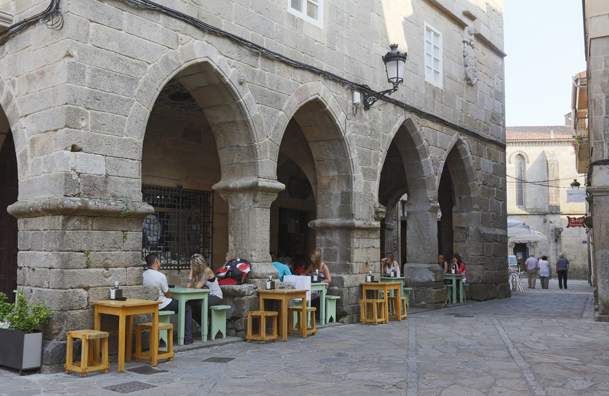
 Just 19 km south from Ferrol there's Pontedeume (Puentedeume in Spanish), a 7,7884 inhabitants town in the estuary of river Eume. The architecture in town is a mixture of wonderful houses, squares and porticoed streets like rúa Real. The town is very linked to Andrade family (just like Betanzos) and there are some buildings in town that belonged to them such as Andrade family castle (13th century castle used currently as a hotel) or Andrade family fortified tower (11-13:30 and 17-20:30 from Jun to Sep; 11-13:30 and 17-19 from Oct to May; 2/ 1  adults/ childs), located in Pontedeume Old Town, 14th century tower that hosts currently an interpretation center about Andrade family. Just 7 km east there's Fragas do Eume Natural Park, a park that contains one of the best examples of Atlantic forest in the whole European continent. This wonderful place is great to get in touch with nature (with different species of trees, anphibians, birds and mammals), breath fresh air and unwind. It also has some historical remains like some cruzeiros or the Monastery of St. Xoán de Caaveiro (free), 10th century monastery founded by St. Rudesind to host the amount of hermits who lived in the area around the year 934.

Where can I eat in Ferrol?

One of the best places to eat here is rúa Pardo Baixo, with restaurants offering menus for less than 12 euros. Some recommendations to eat in Ferrol are Casa Rivera (rúa Galiano 57), Frank (), O Lagar (rúa Igrexa 132) or Nautic (rúa Igrexa 32).

Sunday, 11 August 2019

Fisterra

Fisterra (Finisterre in Spanish) is a 4,701 inhabitants municipality located in what was thought to be the point westernmost of Galicia and of Spain and the end of the world in Roman times (despite Cabo da Roca in Portugal is the truly westernmost point of the European continent). Moreover Fisterra is the last stop for pilgrims of the Way of St. James, in an optional 3-4 days trip.

How do I arrive to Fisterra?

  Fisterra isn't quite well connected to other points of Galicia but it can still be reached from the biggest cities in A Coruña province. 
  • Bus: there are 5-6 buses everyday from Santiago de Compostela to Fisterra (aprox. 3 hours) via Noia (aprox. 2 hours 15 minutes) and Muros (aprox. 1 hour 15 minutes). There are also daily buses from A Coruña reaching Finisterre (aprox. 2 hours)
  • Car: if you rented a car, it's 30 minutes from Muxía, 50 minutes from Camariñas, 1 hour journey from Noia and Muros, 1 hour 15 minutes from A Coruña and 1 hour 20 minutes journey from Santiago de Compostela.

History

Fisterra has always attracted the attention of geographers and historians as it was considered finis terrae (Land's End). In the area the pre-Roman settlement of Villar Vello has been discovered but it hasn't been explored yet. According to Roman sources in this point there was a pagan temple consagrated to the Sun and the parish of Duyo has archaelogical remains of a former Roman town, probably Dugium. From Middle Age Fisterra became an important point of pilgrimage linked to the Way of St. James, being an optional continuation of the pilgrimage that lasts 3 days.


What can I visit in Fisterra?

 Fisterra is a very charming area and for many visitors its atmosphere makes it feel like a special place. Its sunsets are among the best ones in Galicia. 
These are Fisterra' main attractions:
  • St. Carlos Castle (11-14 and 16-18 Mon-Sat, 11-14 Sun from Jul to Aug; 11:30-13:30 and 15:30-18:30 Sat-Sun from Sep to Jun; 2): 18th century castle built to defend the ria de Corcubión in Charles III of Spain times and which was destroyed during the Peninsular War. Nowadays it hosts the Fishing Museum, small museum focused in sardine fishing.
  • St. María das Areas Church (11-13:30 and 16:30-19 from Jun to Sep; closed from Oct to Apr; free): 12th century Romanesque style church which was very popular between pilgrims as the last stop of the Way of St. James. During Easter here it takes place a representation of Jesus Christ' via crucis by locals.
  • In Fisterra there are many beaches that are very nice (although its water is cold) like Langosteira Beach (the most beautiful one), Mar de Fóra Beach (perfect for surfers) or O Rostro Beach. These are some of the most popular ones but in the road from Cee to Fisterra there are many of them.
  • Cape Fisterra: the place that gives the name of the town and what makes it popular is this cape full of cliffs, where the sea seems to have no end. Here stands the most important lighthouse of the Costa da Morte, Cape Fisterra Lighthouse, a 18th century lighthouse whose building also has temporary expositions.
  • Fisterra Seafood Market (16-20 Mon-Fri; 1 in case there's someone controlling, otherwise free): this seafood market (lonxa in Galician and lonja in Spanish) is perfect to see how fishermen sell their products in an auction.
  • Not far from Fisterra (12 km) there's the village of Corcubión, declared conjunto histórico in 1985, a beautiful place to have a walk. A bit further, in the way to Muros and Noia, can be found the fervenza do Ézaro (Ézaro waterfall), photogenic point where the river Ézaro flows into the sea with a waterfall. There's a viewpoint near where getting great views of it and of the area.
Langosteira Beach

View of the town of Fisterra

Virxe da Barca sancturary
From Fisterra to Malpica de Bergantiños it can be done the Camino dos Faros, an awesome 200 km long trail by the seaside. Along this route there are several places that are worth a visit such a Galician traiditional town called Camariñas, 5,322 people, very linked to fishing. Here it can be found the Lace Museum, a museum linked to this ancient cloth art. Continuing 25 km in the road the visitor reaches Muxía (Mugía in Spanish, a 4,736 inhabitants town in the middle of Costa da Morte. The most interesting points to visit are Virxe da Barca Sanctuary (church built in a place where St. James was preaching and Virgin Mary appeared and asked him to back to Jerusalem; the current building dates back to the 18th century), the lighthouse or Moraime Monastery (12th century Romanesque style church and monastery built on a Roman cementery). The nearest interesting sightseeing point to Fisterra is Cape Touriñán and its lighthouse, Cape Touriñán Lighthouse, the real westernmost point in Spain.

Where can I eat in Fisterra?

Despite its small population Fisterra is quite touristic so there's a wide gastronomic offer, always linked to seafood and fish. Some suggestions to eat here are the cheap bars Mirarmar (Paseo Ribeira 22) or A Galeria (Rúa Real 25); other recommendations for a higher prize are Casa Velay (Rúa Cerca 14), Don Percebe (Rúa Alcalde Fernández 8), Ó Fragón (Lugar San Martiño de Arriba 22) or Tira do Cordel (Lugar San Roque 2).

Thursday, 8 August 2019

Noia

Noia (Noya in Spanish) is a 14,337 inhabitants town in the mouth of Tambre river located in the inner part of Ría de Muros e Noia, the northeastern one of the Rías Baixas, in Galicia, Spain. Noia was designed conjunto histórico (heritage listing used to protect entire villages and towns or parts of them) in 1985 and its nickname is Little Santiago de Compostela because of the number of chapels and churches, civil buildings and noble houses it has.

How do I arrive to Noia?

  Noia isn't quite well connected to other points of Galicia but it can still be reached easily from the biggest cities in A Coruña province. 

History

According to a popular leyend in Noia the town was founded when Noah's Ark reached this part of Galicia, naming the settlement after his son Japheth's wife, Noela. The area has been inhabited since before the Roman Empere, being dominated afterwards by the Kingdom of the Suebi and attacked by Bretons. In 1168, to protect the area from the attacks, the king Ferdinand II of León founded Noia. From that moment onwards the settlement grew because of its closeness to Santiago de Compostela and was used as Santiago's port. Antón Varela (also known as Antón de Noya), one of the sailors who travelled with Ferdinand Magellan was born here. During the 16th century the city walways were demolished to increase the size of the town. Noia had 700 guerrilla to fight against the Franch occupation. Noia was also the birth place of Felipe de Castro, a Neoclassic sculptor who worked for the king Ferdinand VII of Spain. Shoes' industry got quite developed in Noia during the Industrial Revolution. The Spanish Civil War caused the emigration of many inhabitants of Noia via Muros to South America and Switzerland and the demolition of some buildings considered republicans.
 

What can I visit in Noia?

Noia has an interesting Old Town that is worth to have a look, observing its façades.
These are Noia' main attractions:
  • St. Martiño Church (8:30-12 and 16:30-20:30; free): 15th century church built in Gallician Gothic style has a wonderful façade with a nice rose window and where the influence of Santiago's Pórtico da Gloria is perfectly visible. Inside there's a beautiful representation of Madonna and Child.
  • St. María A Nova Church (10:30-13:30 and 16-20 Mon-Fri 10:30-13:30 Sat-Sun from Jun to Sep; 10:30-13:30 and 16-18 Mon-Fri 10:30-13:30 Sat-Sun from Oct to May; free): this 14th century Gothic church is placed in the inner part of a graveyard with some nice pieces. Nowadays it hosts the Tombstone Museum, a fascinating museum with gravestones from the 14th century, some of them with plenty of decoration, and a collection of baptismal fonts.
  • Alameda Park: one of the most popular parks in the town for locals to go for a walk. It has many palm trees and some nice cafes.
  • St. Francisco Church: 16th century Gothic church which is located in Alameda Park.
  • There are great views of the ria going 20 km southwest till reaching Castro de Baroña, ruins of a former Celtic settlement by the sea where enjoying the sunset.
St. Martiño Church

View of Noia's Old Town


View of Muros from its port
Going 30 km west from Noia there's Muros, a 9,437 inhabitants town, located in Ría de Muros e Noia, that was designed conjunto histórico in 1970 and that has historical importance as a harbour in Galicia. The architecture in the town is a mixture of popular and stately architecture and it's worthy to have a walk to discover the town and some of its nicest squares: praza Santa Rosa, praza do Cristo and praza Pescaderia. Some of its most important religious buildings are St. Pedro Church- Colexiata de St. María do Campo (most important church of the town is this 15th century one with eclectic style due to the modifications it has suffered all over its existence); or St. Pedro Church-Old Parish Church (17th century church which substitued a 10th century one). Just 2 km north there's Pozo del Cachón Tide Mill (10-14 and 16-19 Tue-Sat; free), the largest of its kind in Spain. Not far from Muros there's the village of Carnota, whose virgin beach is the largest (7 km) in Galicia, and has one of the biggest hórreos (place designed to keep grain protected from mice) in Galicia

Where can I eat in Noia?

Noia is one of the main producers grewers of seafood in Galicia so trying it here is an excellent choice. Other typical dishes are corn empanada (this area grews also a lot of corn). In Muros there festivals related to these dishes in summer. Some recommendations to eat here are Hotel Elisardo (Rúa Coasta do Ferrador 15), Valadares (), Ferrador (Rúa Costa do Ferrador 11) or Tasca Típica (Rúa Cantón 15).

 
Design by Wordpress Theme | Bloggerized by Free Blogger Templates | free samples without surveys