Showing posts with label Africa. Show all posts

Saturday, 6 February 2021

Melilla

Melilla (مليلة in Arabic, ⵎⵔⵉⵜⵙ in Riffian Berber) is a 87,076 inhabitants autonomous city of Spain located in the northwestern coast of Africa, bordering Morocco. It's situated in Cape Three Forks by the Alboran Sea, part of the Mediterranean Sea. The population has mixed Catholic Christian and Muslim traditions (having a small number of Sephardic Jews too) and the official language is Spanish (although Riffian Berber is quite spoken too).

How do I arrive to Melilla?

 Melilla is connected to Spain via Andalusia, although it's a bit expensive to arrive here.
  • Plane: there are national flights to Melilla Airport from the main cities of Spain such as Málaga (aprox. 10 minutes), Seville, Madrid, Valencia or Barcelona
  • Boat: boats depart and arrive to Melilla reaching Almería (aprox. 6.5 hours), Motril (aprox. 5 hours) or Málaga (aprox. 8 hours).
  • Car: the only possible way to access Melilla from Morocco is by car. Melilla can be reached by road from places such as Nador (aprox. 30 minutes), Midar (aprox. 1 hour 50 minutes), Berkane (aprox. 2 hours), Taourirt (aprox. 2 hours 10 minutes), Al Hoceima (aprox. 2 hours 20 minutes) or Fez (aprox. 4 hours 10 minutes). 

History

The city of Melilla traces its history back to the establishment of Phoenician merchants in the 7th century BC. With the Punic decadence, Rusadir became part of the kingdom of Mauretania and then it was incorporated into the Roman province of Mauritania Tingitana in the year 42 AD, named by then as Rusadir. After the arrival and conquer of the area by the Arabs, a war between the cities of Fez and Tremecen causes the population of Rusadir to abandon the already ruins of Melilla. The territory remained abandoned until the 10th century, when it was recovered by Abd al-Rahman III, creating the Taifa of Melilla that became integrated into the Caliphate of Córdoba. The expansion of the Portuguese and Castilians in the north of the Kingdom of Fez during the 15th century culminated with the entry of Pedro de Estopiñán in 1497. Then Melilla became dependent of the Duchy of Medina Sidonia and from 1556, of the Spanish crown. In 1774 Sultan Mohamed ben Abdallah intended to expel Christians from the north coast of Africa (both Ceuta and Melilla) and the siege of Mellilla began, lasting one year. In 1860, with the Treaty of Wad-Ras (signed by Queen Elizabeth II of Spain and Mohammed IV of Morocco), the border limits of the city were established. During the last third of the 19th century and the first of the 20th century, Melilla was the scene of intermittent confrontations that led to the conflict of the Moroccan War. The successive battles of Barranco del Lobo (1909) and Annual (1921) caused by the Africanist policy of King Alfonso XIII, caused a great impact on Spanish public opinion and forced the military alliance between Spain and France that allowed the constitution of the Spanish Protectorate of Morocco (having very positive effects on the economy of Melilla, which became the economic capital of the eastern part of the protectorate). It was in Melilla where the first events of the 1936 military uprising against the Second Republic, which triggered the Spanish Civil War and the establishment of the Franco regime in the country. In 1985, thousands of Moroccans living in the city were granted Spanish nationality. Melillas was until 1995 was a region of the province of Malaga, getting then the status of an autonomous city.


What can I visit in Melilla?

Melilla has a nice Old Town, known as Melilla La Vieja, a large fortress built during the 16th and 17th centuries that contains many of Melilla's most important historical sites. One of the main squares in the city is Plaza de España.
These are Melilla's main attractions:
  • Baluarte de la Concepción Alta
    Baluarte de la Concepción Alta
    : 50 m high tower that comes from the Romanesque period, originally installed in another church which was demolished in 1530, but was rebuilt in the 19th century. Here it's located the Historical Military Museum of Melilla (10-14 Tue-Sun; free), a small museum permanent exhibition, in which military uniforms, models, dioramas, mistresses of all kinds are exhibited; highlighting an Enigma machine, and a saddle of Isabel II and in the high temporary samples, with cannons and mortars on artillery sites.
  • Purísima Concepción Church: 16th century church that is considered BIC, being the oldest church in all Melilla. Its façade is austere but has the venerated
    Purisima Concepción Church
    in Semana Santa


    16th century image of Nuestra Señora de la Victoria in the main altarpiece and other Baroque altarpieces in the interior too. 
  • Melilla Museum (10-14 and 16-20 Tue-Sat; free): museum with a collection of parts and material resulting from local excavations that is placed in Almacén de la Peñuelas, a former 18th century warehouse.It has an ethnographic section dedicated to Sephardic Jews, gypsies and Berber people.
  • Galápagos Beach: popular beach located near the old town of Melilla. It has the Blue Flag certification, as well as Cárabos Beach and Hípica Beach, other nice beaches in Melilla.
  • The city has a series of buildings in ecclectic style that were built in the beginning of the 20th century due to the economic boom of the city,
    Redación de El Telegrama del Rif
    mainly situtated around Calle López Moreno and Calle del Rey Juan Carlos. This area of Melilla, known as Melilla La Nueva, is regarded as one of the best ensanches in Spain, and Melilla is the 2nd city in Spain with most Art Nouveau buildings (behind Barcelona). Some of the most impressing ones Redacción de El Telegrama del Rif (Art Nouveau building designed for the newspaper El Telegrama del Rif, voted as the 8th most beautiful Art Nouveau building in Spain), Antiguo Economato Militar (ecclectic style building, regarded as one of the nicest buildings in Melilla),
    Casa de David J. Melul
    Casa de David J. Melul (building that is one of the highlights of floral Art Nouveau in Melilla), Grandes Almacenes La Reconquista or Edificio de la Cámara Oficial de Comercio, Industria y Navegación de Melilla; all these buildings have been designed by Enrique Nieto y Nieto. Other nice buildings are the Art Deco buildings of Melilla Assembly Palace (building by Enrique Nieto y Nieto, home of the local parliament of Melilla), Edificio Rojo or Monumental Cinema Sport.
  • Hernández Park: Modernist style park, considered the main one in Melilla, by Plaza de España. It was built in 1902 on the old bed of the Río de Oro.
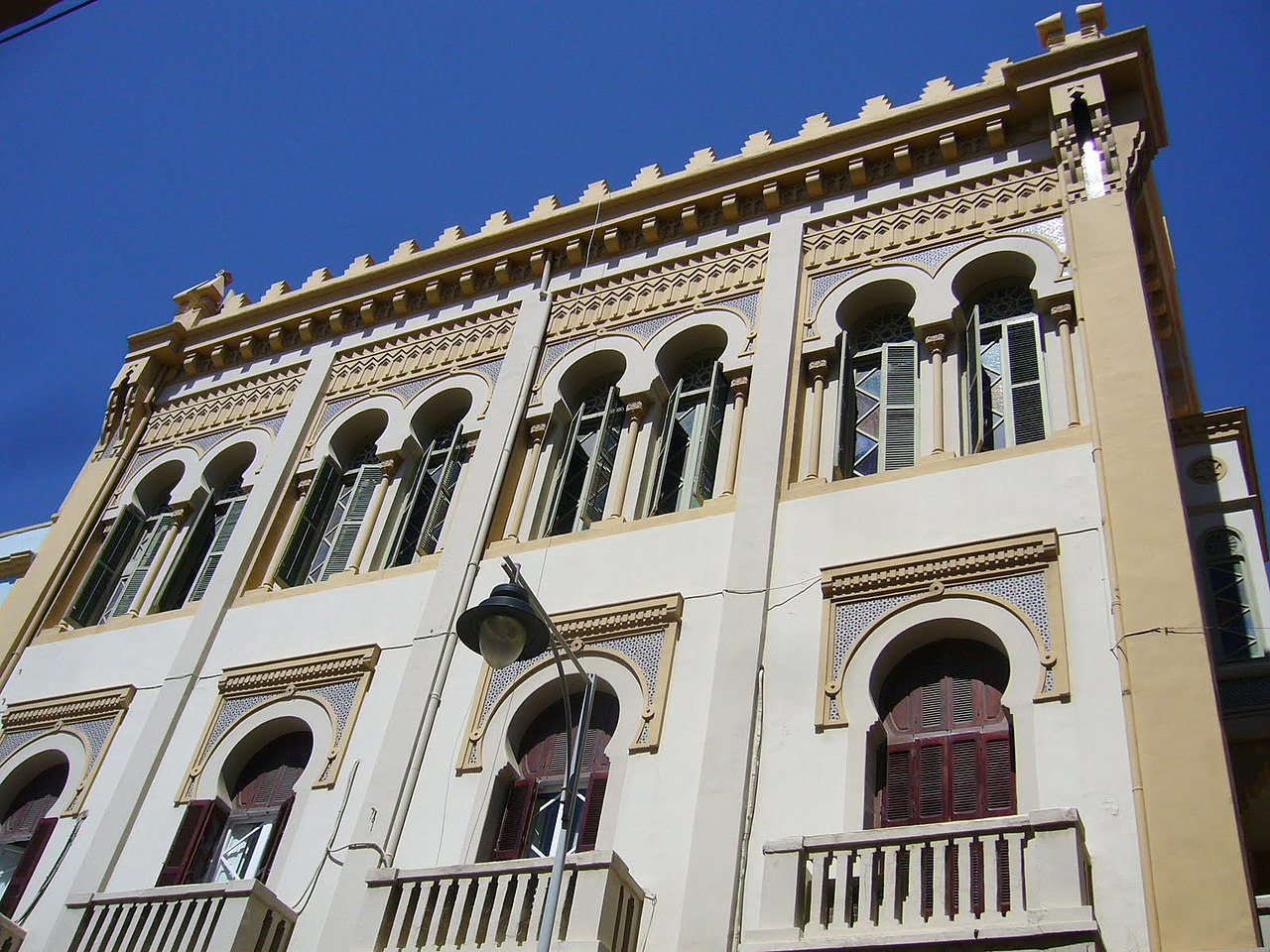
    Yamín Benarroch House

  • Sagrado Corazón de Jesús Church: Neo-Romanesque style church built in 1918 by Fernando Guerrero Strachan (repared by Enrique Nieto y Nieto in 1927), part of BIC list.
  • Yamín Benarroch House: house built in Moorish Revival style in 1924 by Enrique Nieto y Nieto that was declared BIC. It was built for Yamín Benarroch family, hosting their family on the ground floor and on the first floor is the main Jewish temple in Melilla, Or Zaruah Synagogue.
  • Central Mosque of Melilla: mosque built in Moorish Revival style in the 1940s by Enrique Nieto y Nieto. The monument is declared BIC and on the ground floor there are shops and a Turkish bath.
    Central Mosque of Melilla
    Another of the mosques in Melilla is Buen Acuerdo Mosque, a temple from the late 1920s. It was the first mosque built in Spain since the Reconquista.
  • Egyptian Museum of Melilla (): museum that introduce the visitor to the archaeological missions sponsored by the Gaselec Foundation in Egypt, one of the only 3 of its kind in Spain. Some of its highlights are a sarcophagus of Querta, a funeral stele from the end of the 4th century BC, a statuette of the God Amun-Ra, and some terracottas with cuneiform writing.

Where can I eat in Melilla?

  Mixture has a mixture of seafood and Arabic food. Some of the nicest places to eat are the cafe-bar Los Arcos (Plaza Menéndez Pelayo), cafe El Galán (Calle Remonta 5), the Moroccan restaurant El Caracol (Calle de Poeta Salvador Rueda 3) or the restaurant Los Salazones (Calle Conde de Alcaudete 15).

Tuesday, 2 February 2021

Ceuta

Ceuta (سبتة in Arabic) is a 85,144 inhabitants autonomous city of Spain located in the northwestern coast of Africa, bordering Morocco. It's in the boundary between the Mediterranean Sea and the Atlantic Ocean. The population has mixed Catholic Christian and Muslim traditions (between 40-50% of the population are of Moroccan origin) and the official language is Spanish (although Moroccan Arabic is widely spoken too).

How do I arrive to Ceuta?

 Ceuta is connected to Spain via Andalusia, although it's a bit expensive to arrive here.
  • Plane: there are around 4 passenger helicopters from Algeciras (aprox. 10 minutes) and Málaga (aprox. 40 minutes)
  • Boat: boats depart and arrive to Ceuta between 10-20 times per day, reaching Algeciras (aprox. 45 minutes).
  • Car: the only possible way to access Ceuta from Morocco is by car. Ceuta can be reached by road from places such as Tétouan (aprox. ), Tangier (aprox. ), Ksar el-Kebir (aprox. ), Fez (aprox. ), Rabat (aprox. ) or Casablanca (aprox. ). 

History

The first vestiges of human presence in Ceuta date back to 250,000 BC and in the 6th century, Phoenician settlements with the name of Abyla took place. Later it was occupied by Phocian Greeks, who renamed it Hepta Adelphoi and in 319 BC, Carthage would take over the city. With the surrender of Carthage after the Second Punic War, the city was ceded to the Kingdom of Numidia, then passing to Mauritanian rule and was conquered by Caligula in 40 AD, within the Roman province of Mauretania Tingitana. In 429 Ceuta fell into the power of the Vandals, led by its king Gaiseric and in 534, the Byzantine general Belisarius reconquered it, being later recovered by the Visigoths. In 709, Count Julián de Ceuta exchanged loyalties for the Umayyad Caliphate, in 788 it was invaded by the Idrisid emirate and in 931, the Umayyad Caliph Abd al-Rahman III conquered the city for the Caliphate of Córdoba. During the division of the Caliphate into Kingdoms of Taifas it remained under the rule of the Malaga taifa. According to the Treaty of Monteagudo de las Vicarías (1291) between Castile and Aragon, the city remains in the Castile area of ​​influence although by then it was part of the Nasrid Kingdom of Granada. In 1415, King John I of Portugal embarked on the country's first overseas adventure in the area and after the battle of Ceuta, they conquered the city. After a treaty with the Marinid Sultanate, it recognized Ceuta as Portuguese. After the death of Sebastian I of Portugal, Ceuta joined the Hispanic Monarchy in 1580 and when Portugal regained its independence the city preferred to remain under the sovereignty of Philip IV of Spain. Between 1694 and 1724 the siege of Ceuta by the Sultan of Morocco took place, resisting in 1704 the British Royal Navy that took Gibraltar and the rest of the Moroccan sites of the 19th century. Between 1859 and 1860, the Hispano-Moroccan War and an increase in city limits took place. In 1912 the Spanish Protectorate of Morocco was established in its northern area of Morocco and from 1932 Ceuta was incorporated into the province of Cádiz. In 1936 the Spanish Civil War began in Ceuta when the uprising, carried out by Juan Yagüe's troops, prevailed in the city (military and politicians loyal to the government were later shot). Since its independence, Morocco claims sovereignty over the city of Ceuta and over Melilla, which Spain has never been willing to negotiate. In 1995 the Statute of Autonomy of the city was promulgated and Ceuta (together with Melilla) reached the status of an autonomous city. 


What can I visit in Ceuta?

    Ceuta is a nice place to spend a day and discover its interesting history. It has some nice squares such as Plaza de África and Plaza de la Constitución, with the Monumento a Hércules that represents the tenth labour of Hercules (obtaining the cattle of the three-bodied giant Geryon). These are Ceuta's main attractions:
  • Royal Walls of Ceuta
    Royal Walls of Ceuta: line of fortification that date back to 962 in its oldest part and the most modern parts to the 18th century, being the most representative monument in Ceuta and declared BIC. The walls have significant role in the Sieges of Ceuta by Moroccan troops in the 18th century. The structure consist of two large bastions at each end of the wall (called Baluarte de la Coraza and Baluarte de la Bandera) and a smaller bastion at the north flank, protected by a ditch filled with seawater. 
  • Ceuta Cathedral:
    Ceuta Cathedral
    cathedral built between 17th and 18th centuries in a mixture of Baroque and Neoclassical styles in the site where used to be located the old Great Mosque of Ceuta (transformed into a church after the Portuguese conquest of 1415). It's the co-seat of the Diocese of Cádiz and Ceuta. Main
    sights in the cathedral are the Chapel of the Most Holy Trinity (a Baroque altarpiece), the frescoes by Miguel Bernardini and a 15th century figure of the Great Virgin, which is of Portuguese origin.
  • Church of St. María de África: Baroque style church that was used as provisional seat of the cathedral, restored to its current appearance in the 18th century. Its origin is a temple built to host the Gothic image of Our Lady of Africa brought to Ceuta by the Portuguese Prince Henry the Navigator in 1421.
  • Late-Roman Basilica of Ceuta:
    Casa de los Dragones
     ruins of an Early Christian basilica from the end of the 4th century, with a floor plan typical of North African basilicas. It can be seen some parts of the walls and the necropolis.
  • The city has a series of buildings in ecclectic style that were built in the beginning of the 20th century due to the economic boom of the city. Some of the most impressing ones are Ceuta Assembly Palace (Neoclassical style building with frescoes by Mariano Bertuchi, home of the local parliament of Ceuta), Casa de los Dragones (building from 1905 that was designed by José María Manuel Cortina Pérez) or Casa Delgado.
  • Ribera Beach:
    Ribera Beach
    popular beach located near the old town of Ceuta. It has the Blue Flag certification, as well as El Chorrillo Beach, another nice beach in Ceuta.
  • La Legión Museum (10-13 Mon-Sat; free): military museum that celebrates the Spanish Legion (an elite military force directed and created in 1920 by José Millán Astray, framed within the Terrestrial Force of the Spanish Army). It's composed of tables, flags and pennants, photographs and other related materials. 
  • Ceuta Museum (11-14 and 17-20 Tue-Sat, 11-14 Sun; free): small museum on the history of Ceuta with a collection of archaeological pieces from the region of the Strait of Gibraltar from the Ancient Age to the Modern Age. It hosts temporary exhibitions too.
  • St. Francisco Church: 18th century church built on an old Islamic madrasah.
    Parque Marítimo del Mediterráneo
    After suffering the confiscation process of the 19th century, the church survives in poor condition till it was restored in 1919. It was also declared BIC.
  • Parque Marítimo del Mediterráneo (11-20:30;  5.50): leisure complex, designed by César Manrique and inaugurated in 1995, that consists of three artificial lakes of salt water, filtered directly from the sea. These are suitable for swimming during the summer months. There's also a park that contains gardens, ornamental waterfalls, sunbathing areas, a stage for concerts and shows and various entertainment establishments (bars, restaurants, pubs, a casino, a nightclub...).
    Arab Baths of Ceuta
    It has similarities with Parque Marítimo César Manrique in Puerto de la Cruz, Tenerife.

  • Arab Baths of Ceuta: public baths that are located in the former Medina quarter since the 11th century, declared BIC. The baths had one room for clothes and toilets followed by a cold bath and then a hot bath in a style laid down by the Romans. The building was not being used in the 17th century.
  • Nuestra Señora del Valle Church: church founded after the conquest of Ceuta by Portugal as a hermitage on the outskirts of town. The temple began to be rebuilt in 1677.
  • Marinid Walls of Ceuta: set of walls and towers that were constructed in the 13th century during the Berber Marinid dynasty's domination. They were used as a citadel and shelter for troops that were forced to spend the night outside the medieval city. The walls are declared BIC.
  • Muley el-Mehdi Mosque:
    Muley el-Mehdi Mosque
    mosque built in 1940 in gratitude for the support of the Muslim troops to the National side during the Spanish Civil War. Its façades are austere and in its interior religious teaching and Arabic language classes are given. Not far from here is located another mosque built in the 1940s for the same reasons and a similar outlook, Sidi Embarek Mosque.
  • Around Ceuta there are plenty of forts and barracks that can be observed and that provide great views of the city and the sea.

Where can I eat in Ceuta?

 Ceuta has a mixture of seafood and Arabic food. Some of the nicest places to eat are El Secreto de Yuste (Avenida San Francisco Javier 3), the Moroccan restaurant Oasis (Urbanización San Antonio 89), El bistro de George (Calle Alférez Bayton 1 bajo) or the Mediterranean Mesón Restaurante Alberto (Avenida de África 19).

 
Design by Wordpress Theme | Bloggerized by Free Blogger Templates | free samples without surveys