





 11:19
11:19
 Banknotemaniac
 Saarland (Sarre in French) is
a 990 thousand people state in the western part of Germany by the border with Luxembourg and France. It's surrounded by the federal state of Rhineland-Palatinate.
The population has a mostly Catholic
Christian tradition (being one of few German regions with a large groups
of Catholics) and is one of the most religious states in Germany. The
official language is German
(although some dialects/languages related to German are Rhine
Franconian), many people can speak French and in touristic places, English is widely spoken.
The main and capital city of Saarland is Saarbrücken, with other important cities like Neunkirchen or Homburg.
Saarland (Sarre in French) is
a 990 thousand people state in the western part of Germany by the border with Luxembourg and France. It's surrounded by the federal state of Rhineland-Palatinate.
The population has a mostly Catholic
Christian tradition (being one of few German regions with a large groups
of Catholics) and is one of the most religious states in Germany. The
official language is German
(although some dialects/languages related to German are Rhine
Franconian), many people can speak French and in touristic places, English is widely spoken.
The main and capital city of Saarland is Saarbrücken, with other important cities like Neunkirchen or Homburg.How do I arrive to Saarland?
Saarland can be reached in many ways, both from Germany and the neightbouring countries. The main place to reach Saarland is Saarbrücken.
The region of the Saarland was settled by the Celtic tribes of Treveri and Mediomatrici. In the 1st century BC, the Roman Empire made the region part of its province of Belgica and the Celtic population mixed with the Roman immigrants. The region
gained wealth, which can still be seen in the remains of Roman villas
and villages. Roman rule ended in the 5th century, when the Franks conquered the territory.
For the next 1,300 years the region shared the history of the Kingdom of the Franks, the Carolingian Empire and of the Holy Roman Empire. Saarland was divided into several small territories, some of which were ruled by sovereigns of adjoining regions and among the most important of the local rulers were the counts of Nassau-Saarbrücken. From the 17th century onwards the French kings, who wanted to incorporate the territories on the western side of Rhine, repeatedly invaded the area several times. They managed to extend their territory to the river Saar, establishing the city and stronghold of Saarlouis in 1680.
The French Revolution made these small territories lose their sovereignty and after 1792 they made it part of the French Republic (a part in the west was made part of Département Moselle, the center became the Département de Sarre and the east, part of the Département du Mont-Tonnerre). When Napoleon was defeated in 1815, the region was divided again: most of Saarland became part of the Rhine Province of Prussia, another part in the east (present Saarpfalz district) was give to the Kingdom of Bavaria and a small part in the northeast was ruled by the Duke of Oldenburg. French Emperor Napoleon III ordered an invasion across the River Saar to seize Saarbrücken in 1870, beginning the Franco-Prussian War that ended in the Saar region became part of the German Empire.
In 1920, once WW1 was finished, Saarland was occupied by Britain and France under the provisions of the Treaty of Versailles, including portions of the Prussian Rhine Province and the Bavarian Rhenish Palatinate. The League of Nations gave France a mandate to administer Saarland for 15 years (France was quite interested on it because of the importance of natural resources and industry). When Nazi party and Adolf Hitler seized power in Germany, many political opponents to NSDAP fled to Saarland, the only part of Germany that wasn't controlled by the German government. Despite this people wanted to remain under French administration, most of the population (ethnically German) didn't support this idea and, when the 15-year term was finished, there was a plebiscite (1935) to choose between joining France, status quo or joining Germany, getting this last choice almost 91% of the votes. When Germany invaded Poland in September 1939, French forces invaded some villages in Saarland, before withdrawing.
After World War II, Saarland came again under French occupation and administration as the Saar Protectorate (but France didn't manage to gain economic control of German industrial areas like the Ruhr). France did not annex the Saar or expel the local German
population (opposed to fate of Upper Silesia, annexed by Poland in 1949). In 1948, the French government established the Saarland University under the auspices of the University of Nancy. In 1954, France and the Federal Republic of Germany (West Germany) developed a detailed plan called the Saarstatut to establish an independent Saarland (part of Paris Pacts) but 1955 plebiscite, rejecting the plan by 67.7%. On 1956 the Saar Treaty
declared that Saarland should be allowed to join the Federal Republic
of Germany, joining it on 1957 and it established that French,
not English as in the rest of West Germany, should remain the first
foreign language taught in Saarland schools. After unification, the Saar franc remained as the territory's currency until 1959. Since 1971, Saarland has been a member of SaarLorLux, a euroregion created from Saarland, Lorraine, Luxembourg, Rhineland Palatinate, and Wallonia.
- Plane: there are international flights Saarbrücken Airport. It's located 15 km east from Saarbrücken and there are buses every hour from Saarbrücken Hauptbahnhof (aprox. 30 minutes).
- Train: there are trains from Saarbrücken Hauptbahnhof to all over Saarland, sites like Völklinger (aprox. 10 minutes), Saarlouis (aprox. 20 minutes), Homburg and Neunkirchen (aprox. 25 minutes) or Merzig (aprox. 35 minutes). Saarbrücken is also connected with other German cities like Trier (aprox. 1 hour 10 minutes), Mainz (aprox. 2 hours 15 minutes) or Frankfurt am Main (aprox. 2 hours) and with French cities like Metz (aprox. 1 hour) or Paris (aprox. 1 hour 50 minutes).
- Bus: there are buses to German cities like Trier (aprox. 1 hour 20 minutes), Karlsruhe (aprox. 2 hours 15 minutes) or Frankfurt am Main (aprox. 3 hours 20 minutes). Some French destinations are also available like Metz (aprox. 1 hour 10 minutes), Nancy (aprox. 2 hours 15 minutes) or Paris (aprox. 6 hours).
- Car: if you rented a car in Saarbrücken you can reach from there other places in Saarland like Völklingen (aprox. 15 minutes), Neunkirchen and Saarlouis (aprox. 25 minutes), Homburg (aprox. 30 minutes), Merzig and Mettlach (aprox. 40 minutes ). It can also be reached from other German cities like Kaiserlautern (aprox. 50 minutes), Trier (aprox. 1 hour 10 minutes), Mannheim and Worms (aprox. 1 hour 20 minutes), Mainz (aprox. 1.5 hours) or Frankfurt am Main (aprox. 2 hours); French cities like Metz (aprox. 1 hour), Strasbourg (aprox. 1 hour 20 minutes) and Nancy (aprox. 1.5 hours) and or even from Luxembourg, like Schengen (aprox. 1 hour) or Luxembourg City (aprox. 1 hour 30 minutes).
History
.jpg/400px-NennigFu%C3%9FbodenmosaikL1140347_(2).jpg) |
| Roman mosaic in Nennig |
For the next 1,300 years the region shared the history of the Kingdom of the Franks, the Carolingian Empire and of the Holy Roman Empire. Saarland was divided into several small territories, some of which were ruled by sovereigns of adjoining regions and among the most important of the local rulers were the counts of Nassau-Saarbrücken. From the 17th century onwards the French kings, who wanted to incorporate the territories on the western side of Rhine, repeatedly invaded the area several times. They managed to extend their territory to the river Saar, establishing the city and stronghold of Saarlouis in 1680.
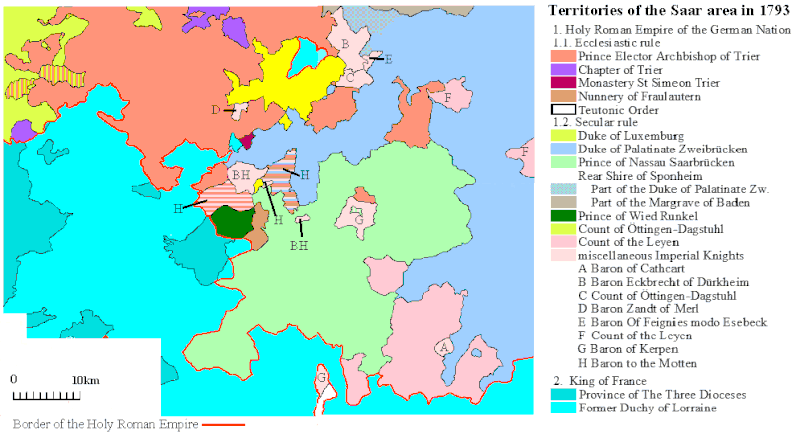 |
| Territories of the Saar area in 1793 |
 |
| Saarland under French administration |
%2C_Dr._Konrad_%2C_Dr._Schneider_stembiljet%2C_Bestanddeelnr_907-3848.jpg) |
| Ballot of 1955 plebiscite |
What can I visit in Saarland?
These aren't so many things to do in Saarland and the most interesting city is clearly Saarbrücken. There's a discount card that includes free access to more than 90 monuments, free train and bus; Saarland Card (free for staying at least 2 nights in Saarland).
 |
| St. Johann Catholic Basilica |
- Saarbrücken (Sarrebruck in French, Saarbrigge in Rhine Franconian, Saarbrécken in Luxembourgish): 180,741 inhabitants city by the border of Germany and France, capital of the Saarland federal state and its largest city. It's main touristic point in Saarland and home of the main campus of Saarland University too. Saarbrücken's Altstadt is built around St. Johanner Markt, its main square, with a nice fountain by Friedrich Joachim Stengel, and Schlossplatz. It also has more than 12 bridges (its name would be translated as Saar bridges).
- St. Johann Catholic Basilica (9:30-19:15): 18th century Barroque style church designed by Stengel with astonishing golden altarpieces, impressing pulpit, organ and ceilling. It stands on the site of the first medieval chapel of the former fishing village of St. Johann an der Saar whose construction, according to the tradition, was ordered by Metz bishop Arnulf von Metz in the 7th century.
- Saarland Museum, Modern Gallery (10-18 Tue-Sun; 7€ /5€ /free adults/ reduced/ people under 18): most important art gallery in Saarland with a very good collection of European art since the late 19th century. It has works German impressionists like Max Slevogt, Lovis Corinth, Max Libermann, French impressionists like Claude Monet, Alfred Sisley or Pierre-Auguste Renoir and expressionists such as Ernst Ludwig Kirchner, Franz Marc and Alexej von Jawlensky. Some of its highlights are Schafe by Franz Marc or Der Strum by August Macke.

Saarbrücken Palace - Saarbrücken City Gallery (12-18 Tue-Fri, 11-18 Sat-Sun; free): art gallery that displays many temporary modern art exhibitions.
- Saarbrücken Palace: 18th century Schloss that has a mixture of Renaissance, Barroque and Neoclassic styles, designed by Friedrich Joachim Stengel for prince William Henry of Nassau-Usingen. Under Nazi regime they also hosted Gestapo's offices in Saarbrücken. On the basement of the palace it can be visited Saar Historical Museum (10-18 Tue-Sun; 6€ /3€ /free adults/ reduced/ people under 18), a very interesting museum that explains the history of Saarland from 1870s to the 1950s.
It shows the period when Saarland was part of France (1920-1935), Nazi period and even a film from 1904 that shows the life in Saarbrücken. There's a combined ticket for all the museums in the palace complex (8€ /5€ /free adults/ reduced/ people under 18).
Saarbrücken Palace Church - Saarbrücken Palace Church (10-18 Tue-Sun; free): former late-Gothic church that used to be part of the palace complex. Nowadays it hosts a sacred art museum with works between the 13th and 19th centuries, including tombs of 3 princes that date back to the 15th-18th centuries.
- Museum Alte Sammlung (10-18 Tue-Sun; 5€ /3€ /free adults/ reduced/ people under 18): musem that shows a collection of paintings, porcelain works, tapestries and sculptures coming from the southwestern part of Germany, Alsace and Lorraine.
- Museum for Pre- and Early History (10-18 Tue-Sun; 5€ /3€ /free adults/ reduced/ people under 18): museum focused on cultures that lived before and during Roman times, incluiding them or Celts. The highlight of the exhibition are some gold jewelry from 400 BC that are thought to have belonged to a Celt princess, found in Bliesbruck-Reinheim.
- Saarbrücken Old Town Hall: Baroque town hall from 1750 built according to plans by Friedrich Joachim Stengel. It was destroyed and rebuilt after WW2.
- Frieden Old Catholic Church: 1743 church built by Friedrich Joachim Stengel.
- St. Ludwig Lutheran Church (10-18 Tue-Sun from Apr to Dec; 12-17 Tue, 10-17 Wed-Sat from Jan to Mar; free): beautiful church from 1775 built by Stengel and it's widely seen as his masterpiece. Its façade is full of characters of the Bible and inside it is decorated in white with stucco. It was rebuilt after WW2.
- St. Jakob Catholic Church: 19th century Neogothic church reconstructed after WW2.
- St. Arnual Lutheran Abbey (10-12 Mon-Fri): abbey was first mentioned in 1135 located in the district of St. Arnual. It's the burial place of the Counts of Nassau-Saarbrücken with the tombs of the Counts of Saarbrücken, including the tomb of the important Countess Elisabeth von Lothringen.
Saarland Modern Gallerie 
Celt jewery at Museum for Pre- and Early History 
St. Ludwig Lutheran Church - Völklingen (Vœlklange in French): 39,374 inhabitants town very close to Saarbrücken and known for its industrial past.

Völklingen Ironworks -
Völklingen Ironworks (10-19 from Apr to Oct; 10-18 from Nov to Mar; 17€ /15€ /free adults/ reduced/ students and people under 18): huge ironworks that is one of the largest remains of heavy industry in Europe, reaching 17,000 employees at its peak in 1965. It stopped working in 1986 and it was declared World Heritage site by UNESCO in 1994. The visitor can, among others, reach the top of a blast furnace (it's needed to wear helmet) where getting fantastic views of whole Völklingern complex and there are some temporary art exhibitions too. At night it has a very colourful illumination, making it look like a science fiction set.
-
Völklingen Ironworks (10-19 from Apr to Oct; 10-18 from Nov to Mar; 17€ /15€ /free adults/ reduced/ students and people under 18): huge ironworks that is one of the largest remains of heavy industry in Europe, reaching 17,000 employees at its peak in 1965. It stopped working in 1986 and it was declared World Heritage site by UNESCO in 1994. The visitor can, among others, reach the top of a blast furnace (it's needed to wear helmet) where getting fantastic views of whole Völklingern complex and there are some temporary art exhibitions too. At night it has a very colourful illumination, making it look like a science fiction set.
- Neunkirchen (Neufeglises in French): 46,469 people town located on the river Blies, in the eastern part of Saarland. It's the 2nd largest town in whole Saarland and birthplace of Erich Honecker, leader of East Germany until the fall of Berlin Wall in 1989.
- Neunkirchen Town Gallery (10-18 Wed- Fri, 10-17 Sat, 14-18 Sun; free): local gallery where some temporary expositions are organised.
- Neunkirchen Town Gallery (10-18 Wed- Fri, 10-17 Sat, 14-18 Sun; free): local gallery where some temporary expositions are organised.
- Homburg (Hombourg in French): 41,811 inhabitants town
in the eastern part of Saarland. It's the 3rd largest city in Saarland. The town is also home of Karlsbeg Brewery, distributed outside Germany as Karlsbräu.

Schlossberg Caves - Homburg castle ruins: remains of the former 12th century castle that belonged to the counts of Homburg, destroyed in 1697 to built Karlsberg Castle (destroyed by Napoleonic troops). It was excavated and partially restored from 1981.
- Schlossberg Caves (9-17 from Apr to Oct; 10-16 from Feb and to Mar and Nov; 5€ /3€ adults/ people under 16): 140 m long and 60 m wide sandstone caves located under Homburg castle ruins whose origin is the mining of colored sandstone. They are considered the largest colored sandstone caves in Europe. There's a combined ticket for Schlossberg Caves and the Roman Museum (8€ /5€ adults/ people under 16).
- Schwarzenacher Roman Museum (9-17 from Apr to Oct; 10-16 from Feb and to Mar and Nov; 5€ /3€ adults/ people under 16): archaeological open-air museum that shows the remains of a Roman vicus (country town) and finds from the everyday life of the Roman population are exhibited.
Saarlouis (Sarrelouis in French): 34,552 inhabitants town in the western part of Saarland. It was built as a fortress in 1680 and named after Louis XIV of France.
St. Ludwig Catholic Church - Ludwig Galerie (10-13 and 14-17 Tue-Fri, 14-17 Sat-Sun; free): art museum part of Ludwig Museum that displays works by regional, national and international artists.
- St. Ludwig Catholic Church: 17th century church greatly rebuilt in the 19th and 20th centuries.
- The town has a very nice park, Saarlouiser Stadtgarten, where having a nice walk.
- Merzig (Mercy in French): 29,745 people town in the western part of Saarland, considered one of the oldest placed in Saarland (it was already inhabited under the Romans).

Fellenberg Palace - Fellenberg Palace (14-17 Thu-Sun; free): 19th century palace that previously was a mill built for manufacturer Wilhelm von Fellenberg and when he died childless, it felt to von Boch family until 1934. Inside there's a museum and some temporary expositions are organised too.
- St. Peter Catholic Church: 13th century church in Rhine-Meuse Romanesque style, regardedd as the largest preserved Romanesque church in Saarland.
- Wolfspark Werner Freund (9-17; free): park dedicatedd to wolves and where the visitor can learn more about these animals.
- Mettlach: 12,049 inhabitants town in the northernwestern part of Saarland, headquarters of an importnat ceramics company, Villeroy & Boch.

Experience center of Villeroy & Boch - Experience center of Villeroy & Boch (10-17 Mon-Sat, 14-17 Sun; 5.50€ /3.50€ /3€ adults/ students/ people under 18): museum and headquarters of the international brand of ceramics Villery & Boch where learning more about ceramics and the company.
- Mettlach Old Tower: remains of a 10th century abbey that was demolished in 1819. It's the oldest preserved sacral building and the oldest preserved upright medieval building in the Saarland.
- St. Lutwinus Catholic Church: Neo-Romanesque church with nice decoration and mosaics.

Cloef viewpoint - St. Joseph Chapel: 19th century Neo-Gothic chapel with a very characteristic decoration inside it.
- It is a great starting point to visit Saarschleife, place by river Saar where it makes a 10 km meander. The best viewpoint is Cloef and it can be reached on a trail (1.7 km) from Orscholz village. On the other side of Saar it's located Montclair Castle (11-18 Thu-Sun from Apr to Nov; 2€), ruins of the castle that used to be one of the most important fortifications on the lower Saar in the Middle Ages.
What and where can I eat in Saarland?
.jpg/1920px-Schales_02_(sk).jpg) |
| Dibbelabbes |
Most of the most interesting places to eat in the state are located in Saarbrücken, precisely around St. Johanner Markt and the surrounding area. Some of the most interesting places to eat are tabern Kalinski (), brewery Zum Stiefel () or the French restaurant Le Comptoir ().
Saarbrücken has an active nightlife too, located between Nauwiesertrae and Cecilienstrae. One of its more popular bars is Baker Street (
Useful links
In case you want to look for more information about Saarland (https://www.visitsaarland.co.uk/) or its cities and towns, here there's a list with some pages to get it:- Saarbrücken (https://tourismus.saarbruecken.de/en).
 Posted in: